

Introduction: The Secret Edge Nobody Talks About
Serena Williams hit thousands of serves before Wimbledon finals. Michael Phelps swam millions of meters in training pools. LeBron James’s physical conditioning is the stuff of legend.
But here’s what the highlight reels don’t show: the hours these athletes spent sitting still, eyes closed, rehearsing in their minds.
Mental training for athletes isn’t a soft concept or a wellness trend. It is, according to a growing body of sports science research, one of the most decisive edges separating good athletes from great ones — and great ones from legends. In 2026, sport psychology has moved from the fringes of athletic preparation to the absolute center of it.
This post breaks down exactly how that works, why it matters more than ever, and what any athlete — at any level — can do to build their mental game starting today.
If you’re also working on the physical side of your game, our guide on the science of injury prevention in sports is a natural companion read — because mental and physical resilience are two sides of the same coin.
What Is Mental Training in Sports?
Mental training, often called sports psychology, refers to the structured practice of psychological skills designed to optimize athletic performance. It’s not about “thinking positively” or giving yourself pep talks. It’s a discipline with specific, trainable techniques — each with measurable effects on performance outcomes.
The four core pillars are:
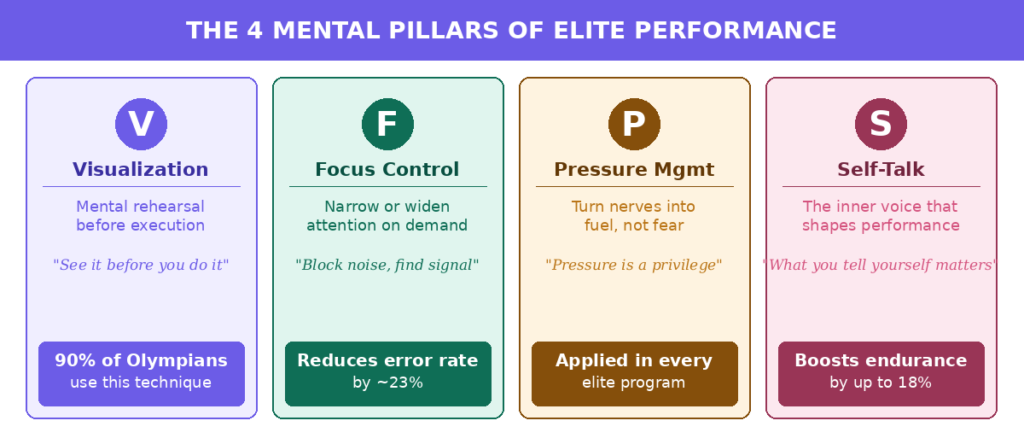
- Visualization — mentally rehearsing movements, decisions, and scenarios before they happen in competition.
- Focus control — learning to narrow or broaden attentional awareness on demand, blocking out irrelevant distractions during critical moments.
- Pressure management — converting pre-competition anxiety into activation energy rather than performance-killing fear.
- Self-talk — the internal monologue every athlete has, reshaped from reflexive negativity into deliberate, functional internal instruction.
These are not soft skills. They are trainable cognitive and emotional capacities, and elite programs around the world now treat them as seriously as speed, strength, and technique.
The Neuroscience Behind the Mental Game
Here’s why mental training works at a biological level: the human brain cannot fully distinguish between a vividly imagined action and a physically performed one.
When an athlete visualizes a free throw, a serve, or a tackle — with enough sensory richness and emotional engagement — the motor cortex, cerebellum, and basal ganglia fire in patterns nearly identical to those activated during actual movement. The neural pathways being used are real. The conditioning is real.
A landmark study published in the Journal of Applied Sport Psychology found that athletes who combined physical practice with structured mental rehearsal improved their performance by 45% more than those who relied on physical practice alone.
This is why Olympic programs in the United States, Great Britain, Australia, and across Scandinavia now embed full-time sport psychologists into their training infrastructure. At the Paris 2024 Olympics, mental performance coaches were part of the official delegation of over a dozen national teams — a number that continues to rise.
The Athlete Who Changed the Conversation
If one moment crystallized the importance of athlete mental health and mental performance for the general public, it was Simone Biles at the Tokyo 2020 Olympics.
Biles withdrew from several events citing mental health concerns — a decision that sparked global debate. What was often missed in the noise: Biles didn’t collapse under pressure. She recognized a mental state — what gymnasts call the “twisties” — that genuinely endangered her physical safety, and she made a decision that required extraordinary self-awareness and psychological literacy.
She came back. She medaled. And she went on to dominate at Paris 2024 — with mental skills coaching as a central pillar of her preparation.
Her story reframed the narrative entirely: mental strength isn’t pretending weakness doesn’t exist. It’s knowing your psychological state with precision and making decisions accordingly.
How Visualization Actually Works — And Why Most Athletes Do It Wrong
The term “visualization” gets thrown around casually, but there’s a significant gap between casual daydreaming about winning and the structured practice that elite athletes use.
Effective visualization has four non-negotiable qualities:
- Specificity. You are not imagining a vague sense of success. You’re rehearsing the exact sequence — the grip, the breath, the footwork, the sound of the ball leaving the bat — in granular detail.
- Multi-sensory engagement. The more senses you recruit, the more neural pathways activate. What do you smell? What’s the ambient noise? What does the surface feel like underfoot?
- Emotional authenticity. Athletes who visualize without emotional engagement get significantly weaker results. You must feel the controlled nerves, the competitive fire, the physical readiness.
- Process, not just outcome. Amateur visualizers picture themselves winning. Elite athletes visualize the performance — the execution, the adjustments mid-play, the response to adversity within the scenario.
Novak Djokovic has spoken extensively about his visualization practice, which includes rehearsing not just perfect serves but specifically what he will do when things go wrong. That preparation for imperfection is, paradoxically, what makes him so difficult to beat when conditions deteriorate.
Pressure Management: Why Your Brain Thinks a Big Match Is a Lion
From your nervous system’s perspective, the serve to win Wimbledon and being chased by a predator trigger the same threat-response cascade: cortisol spikes, heart rate elevates, vision narrows, muscles prepare for explosive action.
In ancestral environments, that response was lifesaving. In sport, it’s a double-edged sword. The same activation that makes an athlete explosive can also cause the fine motor degradation, tunnel vision, and cognitive clouding that leads to what players call “choking.”
This is especially visible in football, where the gap between a penalty scored and one skied over the bar is almost never physical — the sport’s entire pressure architecture is built around moments exactly like this.
The elite solution is not to eliminate the stress response — it’s to reinterpret it.
Sports psychologists call this stress reappraisal: consciously reframing the physical sensations of anxiety as signals of readiness rather than signals of threat. Research from Stanford’s psychology department found that athletes trained in stress reappraisal demonstrated significantly better performance accuracy under high-stakes conditions.
The internal script changes from “I’m nervous, something is wrong” to “I’m activated — my body is ready for this moment.” It sounds simple. The practice of building that automatic reappraisal response takes months of deliberate work — and it genuinely changes outcomes.
Building Your Mental Training Routine: A Starting Framework
Mental training doesn’t require a sport psychologist on retainer — though working with one is worth serious consideration for competitive athletes. Here’s a foundational framework:
- Pre-session mental warm-up (5 minutes). Before any physical training, spend five minutes in quiet visualization of that session’s specific goals. Not general goals — this session’s specific technical focus.
- Post-session reflection log (3 minutes). Write three sentences: what went well mentally, where your focus slipped, and one psychological cue you want to carry into the next session.
- Competition-day routine. Develop a consistent pre-performance ritual that anchors your optimal mental state. The ritual itself is less important than its consistency — your nervous system learns to associate the ritual with the performance state.
- Weekly self-talk audit. Spend ten minutes reviewing the internal language you use when things go wrong during training. Replace evaluative language (“I’m terrible at this”) with instructional language (“Next time, load the hip earlier”).
The Competitive Landscape Has Already Shifted
Here’s the bottom line for any serious athlete reading this: your competitors at the highest levels are already doing this. Mental training is no longer an edge — it’s table stakes for elite performance.
What remains an edge is how deliberately, consistently, and skillfully you apply it.
The athletes who will define the next decade of sport are not simply the fastest, strongest, or most technically gifted. They are the ones who have built the psychological architecture to access their physical gifts under the conditions that matter most: pressure, fatigue, adversity, and the unblinking weight of the moment.
That architecture is built in stillness, in repetition, in the quiet work between the visible performances.
Train your mind. The body will follow.
What mental training techniques do you use in your sport? Drop a comment below — we’d love to hear how the mental game shows up in your athletic life.